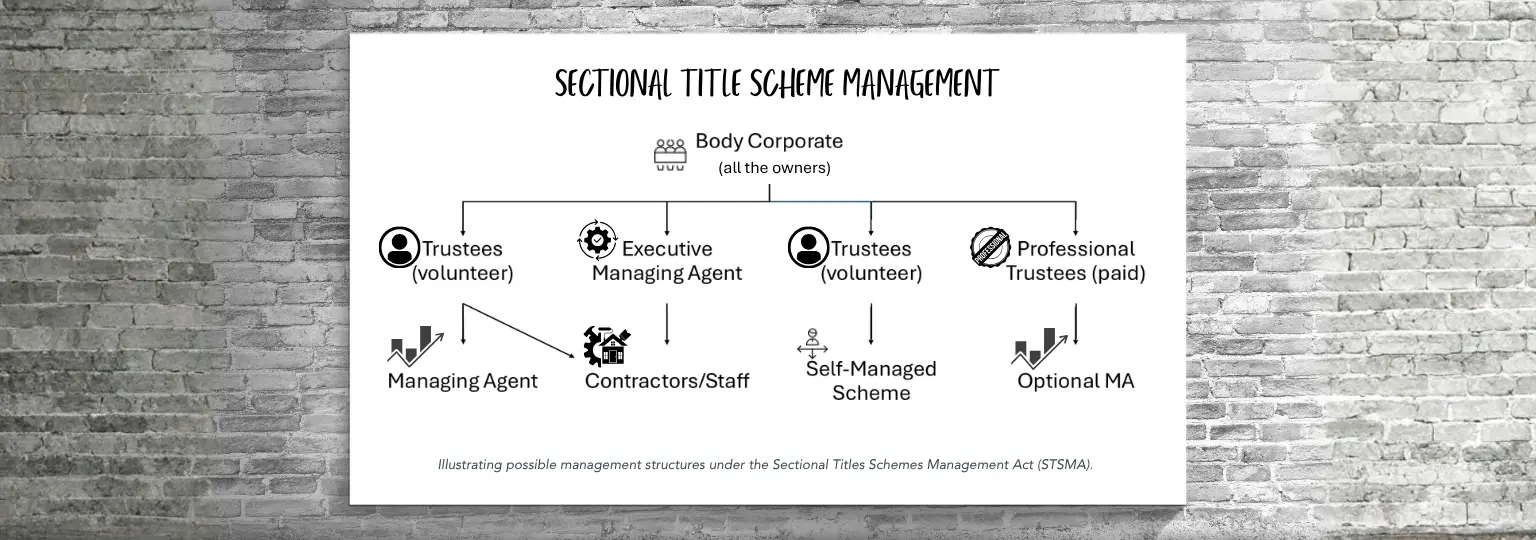



Sectional title scheme management is much like running a small business or community organisation. Success depends on everyone understanding who does what, where responsibilities begin and end, and how decisions flow through the management structure.
The Basics of Sectional Title Scheme Management
No two schemes are identical. The specific combination of trustees, managing agents, professional trustees, or even an Executive Managing Agent (EMA) will depend on the size, complexity, and needs of each community.
This post provides a practical overview of each key role — the Body Corporate, trustees, managing agents, estate managers, and professional trustees — explaining their responsibilities, obligations, and reporting lines. It's not an in-depth legal analysis but a starting point. We'll explore each role in greater detail in future articles.
The Body Corporate (BC) Role in Sectional Title Scheme Management
The Body Corporate is the foundation of every sectional title scheme management framework. It consists of all registered owners (STSMA 2(1)–(3)) and acts as the highest decision-making body. Think of it as the "shareholders" of the scheme: without the Body Corporate, there is no legal entity to manage the property.
Responsibilities: The BC is responsible for the control, administration, and management of the common property (STSMA 2(5); STSMA 3(1)(a)–(t)). This includes everything from approving budgets and levies to making decisions about improvements or special projects (STSMA 3(1)(a)–(f)). While day-to-day management is delegated to trustees (or to an Executive Managing Agent, where one is appointed), ultimate responsibility remains with the Body Corporate.
Obligations: Decisions must be made collectively — no single owner can unilaterally bind the Body Corporate (STSMA 2; STSMA 3).
Reporting line: Trustees act on behalf of, and report back to, the Body Corporate (STSMA 7(1)). If an Executive Managing Agent (EMA) is appointed, the EMA reports directly to the Body Corporate instead of to trustees.
Trustees
Trustees are elected by the owners at the Annual General Meeting (AGM) (PMR 7(4)) and play a central role in sectional title scheme management. They are effectively the "directors" of the scheme, responsible for the day-to-day administration and decision-making within the framework of the law.
Responsibilities: Trustees exercise the functions and powers of the Body Corporate in line with the STSMA, Prescribed Management Rules (STSMA 7(1)), and the scheme's rules. This includes overseeing finances, maintenance, compliance, and governance. Even where a Managing Agent, Estate Manager, or staff are appointed, trustees remain ultimately responsible for control, administration, and management of the scheme.
Obligations: Trustees carry a fiduciary duty (STSMA 8(1)–(2)). They must act honestly, in good faith, and avoid conflicts of interest. Importantly, trustees can be held personally liable if they fail in these duties (STSMA 8(3)). Professional trustees may serve alongside volunteer trustees to strengthen oversight, but all share the same legal obligations.
Appointment and termination: Initially, all members are trustees until the first AGM (PMR 5(1)). Thereafter, trustees are elected annually. A trustee may resign (PMR 6(4)(a)), be removed by ordinary resolution (PMR 6(4)(g)), or simply not be re-elected at the next AGM.
Reporting line: Trustees report directly to the Body Corporate. They may delegate administrative and operational duties to Managing Agents, Estate Managers, or contractors, but they retain ultimate responsibility for oversight and compliance.
Managing Agent (MA)
In sectional title scheme management, a Managing Agent acts as the administrator of the scheme, handling the nuts and bolts of administration and finances. The law defines a managing agent as someone providing scheme management services (Regulation 1).
Responsibilities: Their duties include levy billing, collections, preparing budgets, ensuring statutory compliance, and keeping proper records (PMR 28(1)). A Managing Agent may also assist with arranging maintenance work and facilitating meetings but only under trustee direction.
Obligations: A Managing Agent cannot act independently. They may only carry out functions authorised by the trustees (or the Executive Managing Agent, if one is appointed) and always within the law and the rules (PMR 28(1)–(3)). To safeguard accountability, their appointment must be in writing (PMR 28(5), PMR 9(d), PMR 28(6), PMR 14(4)(b)), and trustees remain ultimately responsible for all decisions (STSMA 7(1)).
Appointment: Trustees may appoint a Managing Agent, or owners may instead appoint an Executive Managing Agent with trustee-level powers (PMR 28).
Change/termination: A management agreement may not endure for more than three years (PMR 28(7)). It may be cancelled, without liability or penalty, despite any provision of the management agreement or other agreement to the contrary:
- By the Body Corporate on two months' notice if the cancellation is first approved by a special resolution at a general meeting (PMR 28(7)(a)); or
- By the Managing Agent on two months' notice (PMR 28(7)(b)).
Disputes about termination can be referred to CSOS for adjudication.
Reporting line: The Managing Agent reports to the trustees (or to the Executive Managing Agent, where applicable). They act in an administrative and advisory capacity. They may not override trustees, nor may they act on any instruction that contravenes the law or the scheme's rules.
Executive Managing Agent (EMA)
An Executive Managing Agent (EMA) is a distinct, legislated role under PMR 28. Unlike an ordinary Managing Agent who assists trustees, an EMA replaces them in exercising their powers.
Definition & authority: Once appointed by special resolution of the owners (PMR 28(1)), the EMA assumes all the powers and duties of trustees, except those specifically reserved for members under the legislation (PMR 28(2)).
Obligations: The EMA is bound by fiduciary duties similar to trustees (PMR 28(3)) and must act in accordance with the STSMA, Regulations, and the scheme's rules.
Appointment: Appointment requires a written agreement (PMR 28(5)), which must also comply with prescribed regulatory requirements (PMR 28(6)). An EMA may still appoint a Managing Agent or staff to assist with administration, but retains full authority and accountability.
Termination: An EMA agreement may not endure longer than three years (PMR 28(7)). It may be terminated without penalty either:
- By the Body Corporate on two months' notice, provided the cancellation is approved by a special resolution (PMR 28(7)(a)); or
- By the EMA on two months' notice (PMR 28(7)(b)).
Practical relevance: EMAs are often appointed where trustees lack the skills, time, or willingness to manage the scheme effectively, making them a governance tool for stability and compliance.
Reporting line: Once appointed by special resolution, the EMA takes over all the powers and functions of the trustees (PMR 28(1)–(2)). The EMA is accountable directly to the Body Corporate (the owners), not to trustees. Trustees no longer function in the usual sense while an EMA is in office, though members still retain powers reserved to them (e.g., passing budgets, special resolutions). The EMA must comply with the STSMA, Regulations, and Prescribed Rules, and owes fiduciary duties equivalent to trustees (PMR 28(3)).
In short:
- Ordinary Managing Agent — reports to trustees.
- Executive Managing Agent — replaces trustees and reports directly to the Body Corporate.
Estate Manager / Caretaker
While this service provider is considered a contractor, the role is often misunderstood — many owners and residents confuse the Estate Manager with the Managing Agent. We've included it here to clarify the distinction.
Some schemes appoint an Estate Manager or Caretaker to handle day-to-day operations. Unlike a Managing Agent, this is an on-site operational role focused on maintenance, supervision, and service coordination.
Responsibilities: Estate Managers typically oversee maintenance, supervise on-site staff, monitor contractors, and liaise with service providers to ensure smooth operations.
Obligations: They must follow trustee (or EMA) instructions and report issues promptly. They do not hold decision-making authority or management powers.
Appointment and termination: The Body Corporate has the power to appoint "agents and employees" (STSMA 4(a)), which includes Estate Managers. Termination is contractual and subject to the terms of the employment or service agreement.
Reporting line: They report directly to trustees, or via the Managing Agent if delegated.
Professional Trustees (Paid Trustees)
In some schemes, owners appoint professional trustees to bring in specialist expertise — for example, financial or legal knowledge. These trustees are particularly useful in larger or more complex schemes.
Responsibilities: Professional trustees carry the same responsibilities as volunteer trustees (STSMA 7). Their expertise does not give them additional powers but often strengthens governance, decision-making, and compliance.
Obligations: They must uphold the same fiduciary duties as all trustees (STSMA 8).
Appointment and remuneration: Professional trustees are appointed by ordinary resolution at the AGM (PMR 7(4)), but they cannot be paid unless the Body Corporate authorises it by special resolution (PMR 8(2)). Professional trustees often serve alongside a Managing Agent, providing governance oversight while the agent handles administrative functions.
Relevant Legislative Context — PMR 8: Payment and Indemnity
- PMR 8(1): Trustees must be reimbursed for actual, reasonable expenses incurred while performing their duties.
- PMR 8(2): Unless otherwise determined by special resolution, trustees who are members (i.e., owners) are not entitled to any reward — monetary or otherwise — for their services. Meaning: if the trustee is also an owner, the body corporate must pass a special resolution to authorise payment.
- PMR 8(3): Trustees who are not members may be paid remuneration as agreed upon by the body corporate at a general meeting or as set out in the approved budget. Meaning: if the trustee is not an owner, their remuneration may be authorised through a budget approval or ordinary resolution, without needing a special resolution.
Termination: Their term ends in the same way as any trustee — removal, resignation, or non-reappointment (PMR 6(4)).
Reporting line: They report to the Body Corporate, serving as trustees, not employees.
Self-Managed Schemes
Not every scheme chooses to appoint a Managing Agent or Estate Manager. In many cases, particularly smaller or less complex developments, the trustees themselves take on all the administrative, financial, and maintenance responsibilities. These are known as self-managed schemes.
Responsibilities: Trustees in self-managed schemes must still ensure that levies are collected, financial records are kept, and maintenance is carried out. The absence of a Managing Agent does not reduce their legal obligations under the STSMA — trustees remain fully responsible for control, administration, and management (STSMA 3 and 7).
Challenges: While this approach can save costs, it requires significant time, organisation, and commitment from volunteer trustees. Lack of expertise or oversight can lead to delays, errors, or even non-compliance with the Act and Prescribed Rules.
When appropriate: Self-management can work well in smaller, low-maintenance schemes where trustees are motivated and capable. However, in larger or more complex developments, the workload often becomes impractical for volunteers, and trustees may opt to appoint a Managing Agent or Executive Managing Agent under PMR 28 to ensure proper governance.
Reporting Lines Explained
The reporting structure in sectional title scheme management is straightforward but often misunderstood:
- The Body Corporate (all owners) appoints the trustees (STSMA 2; PMR 7(4)).
- Trustees report to the Body Corporate.
- Trustees may appoint Managing Agents, Estate Managers/Caretakers, or contractors to assist (STSMA 4(a); PMR 28). These service providers act under trustee (or EMA) supervision and have no independent authority.
- Where an Executive Managing Agent (EMA) is appointed by special resolution, the EMA replaces the trustees in exercising their powers and reports directly to the Body Corporate (PMR 28(1)–(2)).
- Owners retain the right to access scheme records (PMR 27(4)).
- Trustees and MAs/EMAs cannot act as "gatekeepers" of information — transparency is required by law.
In short: the Body Corporate is the source of authority. Trustees act on its behalf unless replaced by an EMA, and everyone else supports them in carrying out their duties.
Owners' Rights of Access in Sectional Title Scheme Management
Transparency is not optional in sectional title scheme management. The law gives every owner the right to see how their scheme is being run.
PMR 27(4): Owners may inspect records without charge, but the Body Corporate may require payment for copies of documents (PMR 27(4)(b)).
Records the Body Corporate must keep (PMR 27(1)–(3)):
- Financial records: Books of account, records of income and expenditure, assets, liabilities, and bank statements.
- Administrative records: Minutes of general and trustee meetings, written resolutions, a list of trustees, members, and tenants, and all contracts entered into by the Body Corporate (including with managing agents, service providers, and caretakers).
- Governance and compliance documents: The scheme's rules, copies of insurance policies, and correspondence sent or received by the Body Corporate.
Practical meaning: Owners may request to inspect or obtain copies of these documents. Trustees or Managing Agents cannot refuse access on grounds of "confidentiality" or by gatekeeping. Only requests that are unreasonable, disruptive, or abusive may justifiably be declined. If a request is ignored or denied without valid cause, owners can escalate the issue to the Community Schemes Ombud Service (CSOS).
Read the blog post: Honouring Owners' Rights: 7 Essential Tips for Trustees
Closing Thoughts
Sectional title scheme management works best when everyone understands the structure. The Body Corporate sets the direction, trustees implement it, and appointed professionals support them. With clear roles and transparent reporting lines, schemes run smoothly, accountability is maintained, and disputes are minimised. Owners who know how these roles fit together are better equipped to protect their rights and contribute to effective governance.
Legislative Reference Guide
Sectional Titles Schemes Management Act (STSMA)
- STSMA 2 — Establishment and membership of the Body Corporate.
- STSMA 3 — Functions of the Body Corporate.
- STSMA 4 — Powers of the Body Corporate.
- STSMA 7 — Trustees' functions and authority.
- STSMA 8 — Fiduciary duties of trustees.
Sectional Titles Schemes Management Regulations
- Regulation 1 — Definition of "managing agent."
Annexure 1 — Prescribed Management Rules (PMR)
- PMR 5(1) — Trustees until first AGM.
- PMR 6(4) — Disqualification and termination of trustees.
- PMR 7(4) — Nomination, election, and replacement of trustees.
- PMR 8(2) — Remuneration of trustees.
- PMR 9(d) — Written contract requirement for agents/employees.
- PMR 14(4)(b) — Resolutions as written instruments.
- PMR 27(4) — Owners' access to records.
- PMR 28(1)–(7) — Appointment, obligations, compliance, and termination of Managing Agents.
Community Schemes Ombud Service Act (CSOSA)
- CSOSA — Provides dispute resolution (relevant for termination of MAs and governance disputes).
What this means for you: These clauses are the foundation. Knowing them arms you with the ability to challenge unlawful decisions.
Key Takeaways
- The Body Corporate is all owners together — ultimate accountability always rests with them.
- Trustees are the "directors" of the scheme and cannot shift accountability to a Managing Agent.
- A Managing Agent administers; an Executive Managing Agent replaces trustees entirely.
- Estate Managers carry out operational instructions — they make no policy or financial decisions.
- Professional trustees hold the same fiduciary duties as volunteer trustees.
- Owners have a legal right to access scheme records under PMR 27(4).
- If transparency is withheld, owners can escalate to CSOS.
Ready to Govern With Confidence?
Give your trustees the verified legislative support the role deserves.
Start Free 14-Day Trial Ask Us a QuestionAdditional Resources
Download these comprehensive guides to deepen your understanding of sectional title governance:
- EstateIQ Resources — Trustee meeting document templates, guides, and reference materials purpose-built for South African sectional title schemes.
- Your Essential Guide to Sectional Title Living — A practical guide covering rights, responsibilities, levies, maintenance, and decision-making for sectional title owners and trustees.
- Sectional Title Terminology Reference Guide — Plain English explanations of sectional title terms from STSMA, PMRs, and CSOSA legislation with practical examples.
- Sectional Title Trustee Support & Networking — Join our Facebook Group for trustees and owners navigating community scheme governance.
This is not a legal advisory blog post. Always check the relevant legislation or consult a sectional title legal specialist.