


Can you trust AI for sectional title answers? Our blind test of thirteen questions says: not always.
Sectional title AI accuracy in day-to-day governance has become increasingly important in conversations with trustees and owners over the past few months. When faced with a difficult question — whether about quorum requirements, trustee powers, levy calculations, or meeting procedures — many go straight to Google or ask a general AI tool for guidance. It feels quick and practical in a world where trustees are already stretched thin. But one wrong clause can invalidate a meeting, derail a levy decision, or create unnecessary conflict.
Speed only helps when the information is reliable, and that's where things get complicated.
Trustees work in an environment where decisions must align with legislation. Yet many turn to Google or general AI tools for quick answers. It feels practical. It feels efficient. But it can also be risky when the information provided is inaccurate, outdated, or simply fabricated.
This article explores what we found when we tested three AI systems and web search tools across thirteen questions. It also provides guidance on how trustees can use technology responsibly while maintaining confidence in their decisions.
Understanding Sectional Title AI Accuracy
Sectional title governance is built on precision. Every rule, every vote, every quorum calculation depends on legislation. Trustees are expected to act reasonably, fairly, and within the law. But the law is complex. Searching online often produces a mix of high-quality material, outdated articles, and content from other jurisdictions.
General AI tools add another layer of uncertainty because they rely on large, mixed datasets that sometimes include inaccurate or superseded information. Trustees need clarity, and sectional title AI accuracy plays a meaningful role in achieving it.
What We Tested and Why
EstateIQ conducted a blind test to understand how different systems perform when answering sectional title questions. Thirteen queries were used. Ten required exact legislation. Three were real-world, complex scenarios trustees commonly face. An independent evaluator reviewed all responses without knowing which system had generated them.
The purpose wasn't to prove perfection. It was to understand how sectional title AI accuracy compares with general AI and web search results so trustees can make informed choices.
What the Results Revealed
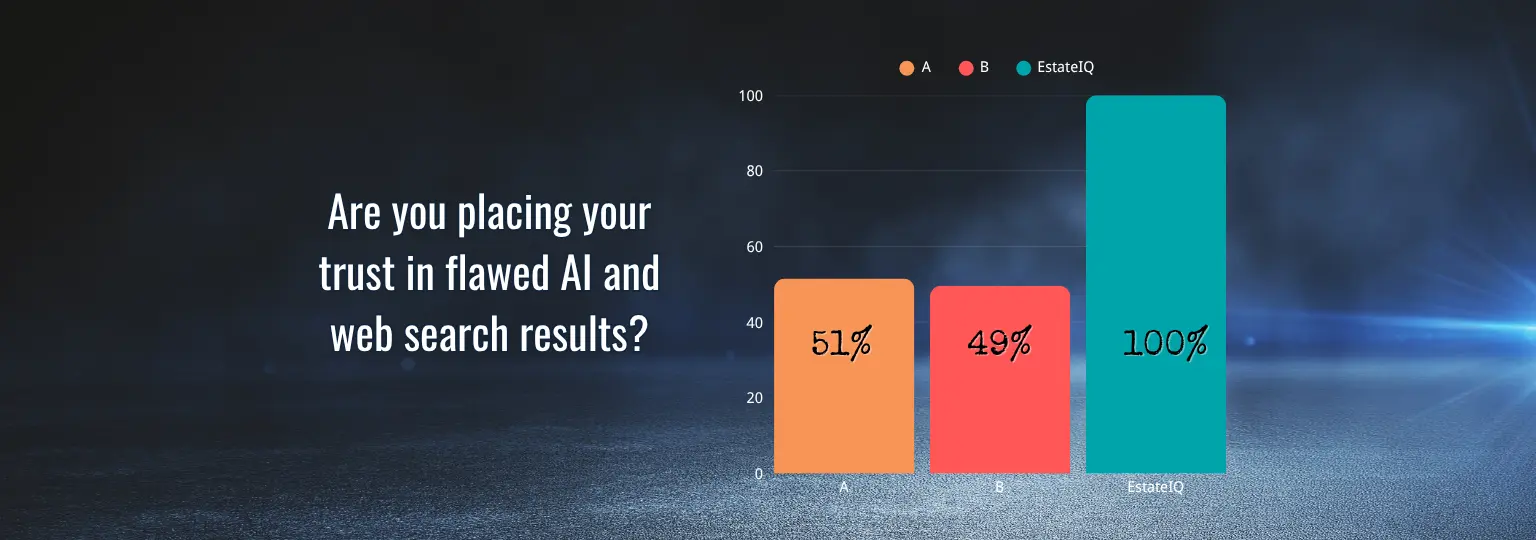
EstateIQ AI Assistants performed well in this test, achieving full accuracy across all questions. The other systems scored around fifty percent. The gap was significant — not only because they misunderstood some concepts, but because they quoted legislation that does not exist.
For example, some responses referenced provisions such as "Section 37(2) of the STSMA", "PMR 58" and "PMR 6(5)". None of these provisions exist. The risk is clear, and it underscores why sectional title AI accuracy matters when trustees rely on digital tools for guidance.
There were also instances where the law was misapplied, or where responses failed to provide any legislative references at all.
Understanding the Difference Between Web Searches and General AI
Web searches can surface up-to-date information, but they rely on what exists online. Some sources are excellent. Others are outdated or inaccurate. Trustees must decide which are reliable.
General AI models work differently. They may pull information from the internet in real time, but they also depend heavily on the older training data they were built on. This means that while a live search may surface something current, the model itself may still draw from information that is outdated, incomplete or inconsistent. When a clear answer is not available, a general AI model may generate a response that sounds correct but has no legislative basis at all.
The Limits of How General AI and Web Searches Interpret the Law
One of the clearest differences observed when building and testing the EstateIQ AI Assistants is how they interpret complexity. Sectional title legislation is interconnected across the STSMA, its Regulations, the Prescribed Management Rules and the CSOS Act. Many questions trustees ask do not sit neatly within one clause.
EstateIQ AI Assistants are able to interpret these questions holistically because they work within the full legislative set. When a question relates to quorum, exclusive use, trustee duties or meetings, the assistant can consider multiple provisions at once and explain how they fit together.
General AI tools and web searches respond differently. They tend to narrow in on the exact words typed into the query, often missing the wider context.
A More Focused Approach
EstateIQ AI Assistants operate within a verified legislative dataset. They don't search the web and don't rely on unverified external sources. This reduces the likelihood of fabricated or misattributed laws. It doesn't eliminate the need for oversight, but it does lower the burden on trustees who need accurate references quickly.
How Trustees Can Use These Tools Safely
Trustees using general AI or web searches need to approach each answer with caution. If a reference looks unfamiliar, check it. Confirm that the rule or section exists. Make sure the legislation cited applies to the topic at hand.
When using EstateIQ, far fewer checks are required because the system is limited to verified legislation. Trustees can still confirm key references as part of good governance, but the risk of encountering made-up law is significantly reduced.
Real-World Implications for Trustees
The consequences of relying on incorrect information aren't academic. Trustees can unintentionally invalidate decisions, run meetings incorrectly, or provide owners with guidance that contradicts the law.
Using tools grounded in verified legislation gives trustees a stronger foundation and contributes directly to better sectional title AI accuracy throughout their decision-making.
EstateIQ Insight
EstateIQ is designed to support trustees with reliable information. It doesn't replace judgment or responsibility, but it strengthens the knowledge trustees rely on. In a landscape where general AI and web searches mix good information with errors, a more controlled approach reduces uncertainty and helps trustees act with confidence.
Conclusion
Trustees need tools that help them navigate the complexities of sectional title legislation. General AI and web searches can assist with context, but they also introduce risk. EstateIQ provides a more dependable foundation by drawing from a curated legislative dataset. EstateIQ won't replace trustee oversight, but it does reduce the noise, errors and guesswork that come with general AI and web searches. Explore the AI Assistants and see how they support clearer, more confident decisions.
Key Takeaways for Trustees
- General AI and web searches can produce incorrect or fabricated legislative references.
- EstateIQ reduces this risk by drawing only from verified legislation.
- Sectional title AI accuracy matters because trustee decisions depend on correct legal interpretation.
- Trustee oversight is still required, but the verification burden is significantly reduced.
Ready to Govern With Accurate Legislation?
See the difference verified legislative guidance makes for your scheme.
Start Free 14-Day Trial Ask Us a QuestionAdditional Resources
Download these comprehensive guides to deepen your understanding of sectional title governance:
- EstateIQ Resources — Trustee meeting document templates, guides, and reference materials purpose-built for South African sectional title schemes.
- Your Essential Guide to Sectional Title Living — A practical guide covering rights, responsibilities, levies, maintenance, and decision-making for sectional title owners and trustees.
- Sectional Title Terminology Reference Guide — Plain English explanations of sectional title terms from STSMA, PMRs, and CSOSA legislation with practical examples.
- Sectional Title Trustee Support & Networking — Join our Facebook Group for trustees and owners navigating community scheme governance.
This is not a legal advisory blog post. Always check the relevant legislation or consult a sectional title legal specialist.